
2026-11-10


News
Solar Tracker Advantages: Efficiency, ROI & System Comparison
- Categories:News
- Author:
- Origin:
- Time of issue:2026-09-29
- Views:0
(Summary description)Explore the key solar tracker advantages, including energy yield gains, levelized cost of energy (LCOE) reduction, bifacial synergy, and smart wind protection.
Solar Tracker Advantages: Efficiency, ROI & System Comparison
(Summary description)Explore the key solar tracker advantages, including energy yield gains, levelized cost of energy (LCOE) reduction, bifacial synergy, and smart wind protection.
- Categories:News
- Author:
- Origin:
- Time of issue:2026-09-29
- Views:0
Information
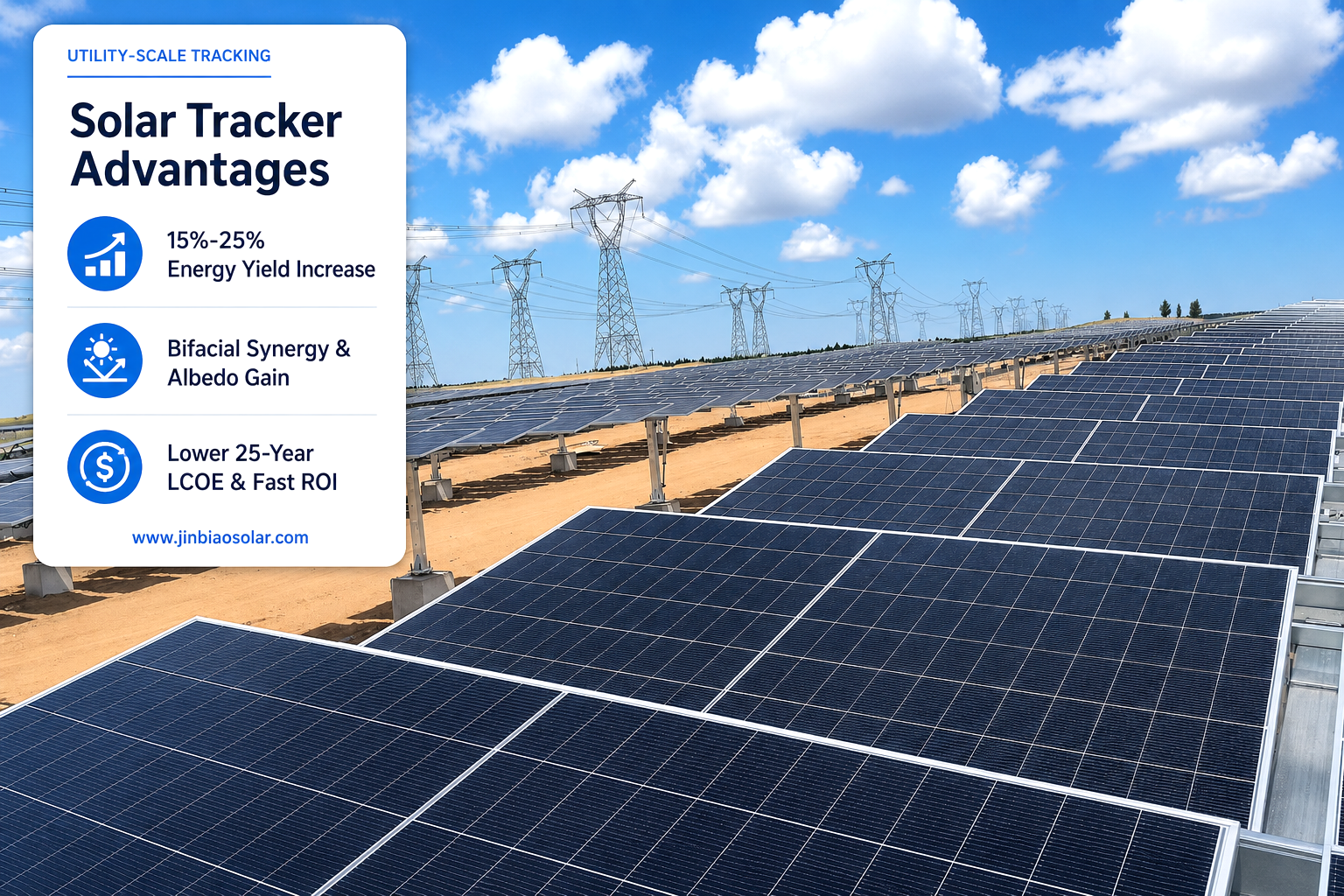 As commercial and utility-scale photovoltaic projects strive for greater energy yields and lower levelized cost of electricity (LCOE), evaluating solar tracker advantages has become a standard step in modern plant design. Unlike stationary installations, a dynamic solar tracking system rotates photovoltaic modules throughout the day to follow the sun's trajectory, optimizing the angle of incidence and significantly expanding daily peak production hours.
While traditional stationary solar mounting systems remain cost-effective for space-constrained rooftops or complex slopes, tracking technology has emerged as the preferred choice for large ground-mounted arrays. This guide outlines the primary technological, financial, and operational benefits of deploying solar trackers.
1. Measurable Energy Yield Improvements
The most prominent of all solar tracker advantages is the substantial increase in total kilowatt-hour generation. Standard horizontal single axis tracker configurations typically enhance annual energy output by 15% to 25% compared to fixed-tilt racking in similar geographic regions.
- Broadened Production Curve: Fixed-tilt arrays produce a sharp bell curve peaking briefly at solar noon. In contrast, trackers flatten this curve, maintaining elevated generation during early morning and late afternoon hours.
- High-DNI Climate Performance: In regions with high direct normal irradiance (DNI)—such as arid deserts, semi-arid plains, and Mediterranean climates—the output gains can be even more pronounced.
- Dual-Axis Capability: For specialized applications, high-precision astronomical dual axis trackers can boost yields by up to 35%, although single-axis systems offer the most balanced capital-to-yield ratio for commercial scale projects.
2. Synergy with Bifacial PV Modules
The convergence of bifacial module technology and single-axis trackers represents one of the most effective yield-optimization strategies in contemporary solar engineering.
- Enhanced Rear-Side Irradiance: Because solar trackers maintain modules at higher elevated ground clearances than standard ground mounts, more diffused and reflected light reaches the module underside.
- Albedo Optimization: Highly reflective surfaces (such as light gravel, sand, or snow) reflect substantial sunlight toward the rear cells, adding an extra 5% to 15% bifacial gain on top of tracking benefits.
- Minimal Structural Obstruction: Engineered torque tubes and low-profile purlins minimize shading across rear glass, preserving electrical string balance throughout rotation.
3. Improved Project Economics and Lower LCOE
While dynamic tracking mechanisms require a modest initial capital expenditure premium over stationary racks, the lifetime financial metrics frequently favor trackers.
- Lower Levelized Cost of Electricity (LCOE): Because trackers deliver substantially more energy from the same inverter and interconnection capacity, the cost per generated megawatt-hour is generally lower over a 25-year lifecycle.
- Higher Value Generation Hours: Generating power earlier in the morning and later in the afternoon frequently aligns with high wholesale tariff windows, maximizing revenue in merchant power markets.
- Faster Payback Periods: Accelerated revenue generation often offsets initial equipment costs within three to five operating years, depending on local feed-in structures.
4. Land Use Optimization and Ground Adaptability
Utility project developers must carefully balance land acquisition, grading costs, and plant layout efficiency. Modern tracking architectures provide flexible layout adaptability:
- Terrain Following Architectures: Advanced single-axis trackers feature articulating drive joints and cardan couplings that accommodate north-south ground slopes up to 15% without extensive civil earthwork.
- Smart Backtracking Algorithms: Automated backtracking algorithms adjust module angles during sunrise and sunset to prevent adjacent row-to-row shading, allowing tighter ground cover ratios (GCR) without compromising yield.
- Complementary Applications: For urban and commercial settings with zero additional ground acreage, specialized structures such as solar carport systems deliver covered parking while serving similar dual-benefit clean energy goals.
5. Automated Safety Stow Protocols
Dynamic movement introduces mechanical components, but it also provides a unique structural defense mechanism that stationary racks cannot replicate.
- High-Wind Defense: Integrated anemometers trigger emergency stow protocols when wind speeds exceed safe operational limits. Trackers automatically rotate to horizontal or low-angle aerodynamic positions to minimize uplift forces and structural torsion.
- Hail Mitigation: When severe storm warnings are issued, remote network controllers can stow modules at steep angles (e.g., 50° to 60°), significantly decreasing the kinetic impact energy of falling hailstones.
- Snow Shedding: In winter conditions, arrays can be tilted to accelerate snow slide-off, restoring generation hours much faster than snow-covered stationary arrays.
The combination of superior energy production, reduced LCOE, seamless bifacial compatibility, and smart storm protection confirms the compelling solar tracker advantages for commercial and utility deployments. By pairing robust hot-dip galvanized structural engineering with precision algorithmic controls, solar project owners can achieve durable asset reliability and optimized investment returns across the entire lifecycle of their renewable power plant.
Keyword:
Scan the QR code to read on your phone
Relevant Information


Contact Us

Headquarters Address: East District, Industrial Park, Anping County, Hengshui City, Hebei Province

Tel:+86-15612159655

whatsapp:+8615612159655

Message
客户留言
Description:
Follow Us On Social Media


Hebei Jinbiao Construction Materials Tech Corp., Ltd.